
Why retail marketing has changed
Retail has evolved. It is no longer just about products on shelves or window displays designed to catch the eye. Consumers today expect more. They are not simply shopping. They are exploring, discovering and deciding where to spend their attention.
This is where Experiential Marketing in Retail has become essential within retail environments.
Brands that succeed on the high street are no longer the ones that are just visible. They are the ones that are felt. They create:
- Energy
- Atmosphere
- Interaction
- Moments worth stopping for
In high-footfall locations such as Oxford Street, where competition is constant, experiential marketing becomes one of the most effective ways to stand out.
The difference between retail presence and retail experience

Many brands invest heavily in retail presence. This includes:
- Window displays
- In-store branding
- Visual merchandising
These elements are important, but they are passive. They rely on people choosing to engage.
Experiential marketing shifts this dynamic. It gives people a reason to stop. It interrupts their journey in a way that feels interesting rather than intrusive. It transforms a retail space from something people walk past into something they move towards.
Understanding behaviour on the high street
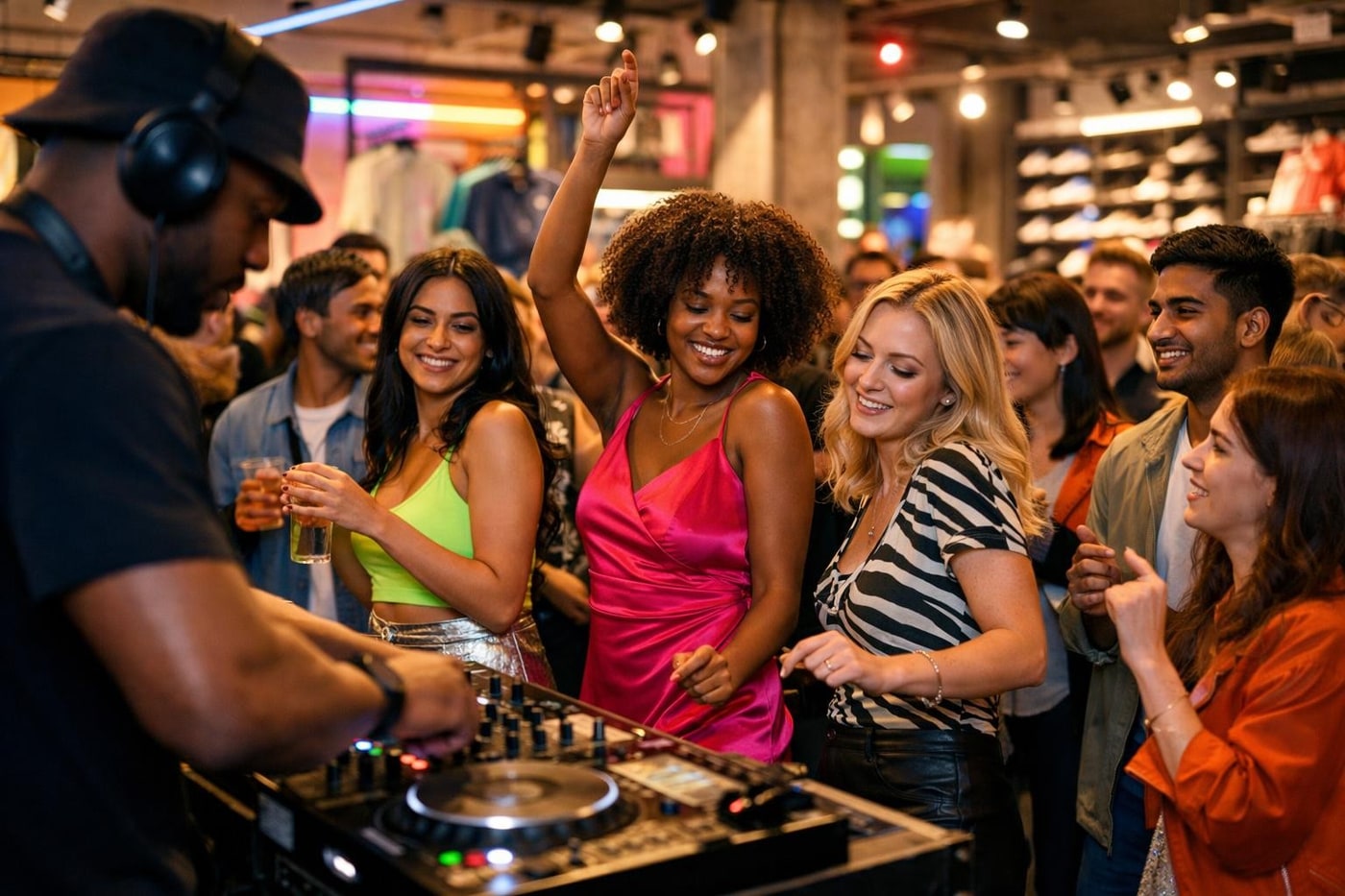
To design effective experiential marketing, you need to understand how people behave in retail environments.
Most people are:
- Moving quickly
- Focused on a destination
- Filtering out distractions
They are not actively looking for brand activations. This means your activation must:
- Capture attention instantly
- Communicate clearly
- Invite engagement without effort
If it takes too long to understand, it will be ignored. If it feels passive, it will be overlooked. If it feels like advertising, it will be avoided.
Creating immediate impact
The first objective of any retail activation is to stop people. This requires impact.
Impact is created through:
- Movement
- Sound
- Colour
- Energy
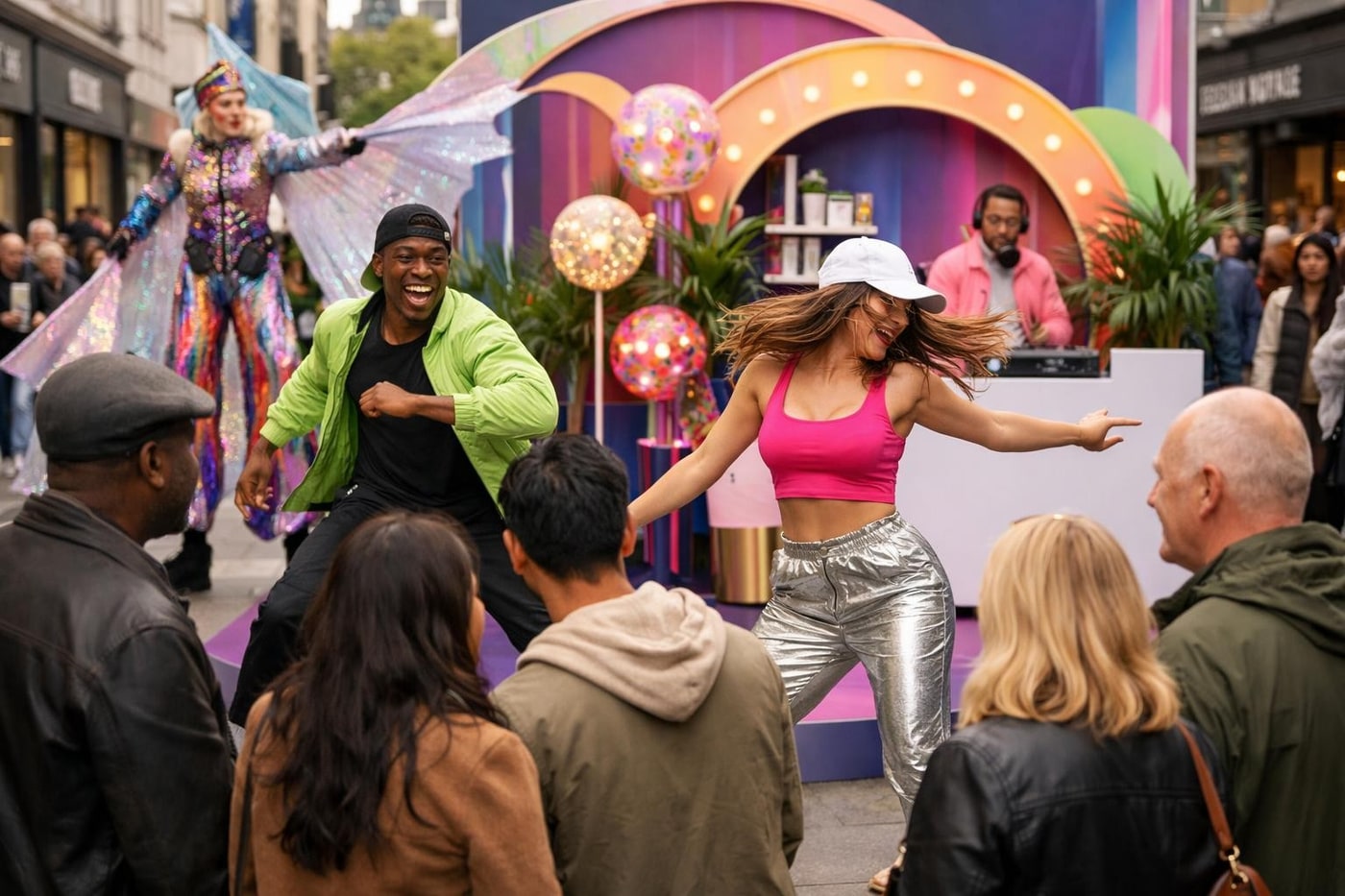
In the Swatch activation on Oxford Street, the approach was built around this principle. Rather than relying on static displays, the activation introduced a live DJ, a breakdance crew and bold, colourful styling. This combination created something that could not be ignored.
People noticed before they understood. That is the key.
To see how this worked in practice, read our Swatch brand launch case study.
Why movement is the strongest attention trigger

Movement naturally draws the eye. In busy environments, it cuts through visual noise. This is why live performance is so effective in retail. It creates:
- A focal point
- A sense of activity
- A reason to stop
As soon as people see movement, they look. As soon as they look, they slow down. This is where engagement begins.
Building a crowd and using social proof
One of the most powerful drivers of engagement is social proof. People are drawn to crowds. When they see others watching, they assume something is worth seeing.
This is why experiential marketing should be designed to:
- Create a focal point
- Encourage small gatherings
- Allow crowds to build naturally
At the Swatch activation, the performance created that focal point. Once a small group formed, it grew quickly. This is how momentum builds.
Turning attention into interaction
Stopping people is only the first step. The real value comes from interaction.
This is where many retail activations fall short. They attract attention but fail to convert it into engagement.
To avoid this, the activation must:
- Offer something to do
- Make participation feel easy
- Remove any hesitation
In practice, this could include:
- Product interaction
- Informal conversations with brand ambassadors
- Moments that invite curiosity
The transition from watching to engaging must feel natural.
Designing the experience around the brand
Experiential marketing should not feel separate from the brand. It should feel like an extension of it.
For Swatch, the brand identity is:
- Bold
- Colourful
- Energetic
- Youthful
Every element of the activation reflected this. The costumes, the music, the performance style and the overall atmosphere were aligned with the brand. This ensured the experience felt authentic.
Creating shareable moments
Retail activations are no longer limited to physical interaction. They extend into digital spaces through content.
People are more likely to share experiences that are:
- Visually engaging
- Dynamic
- Unique
To encourage this, the activation should:
- Look strong on camera
- Include movement and energy
- Provide moments worth capturing
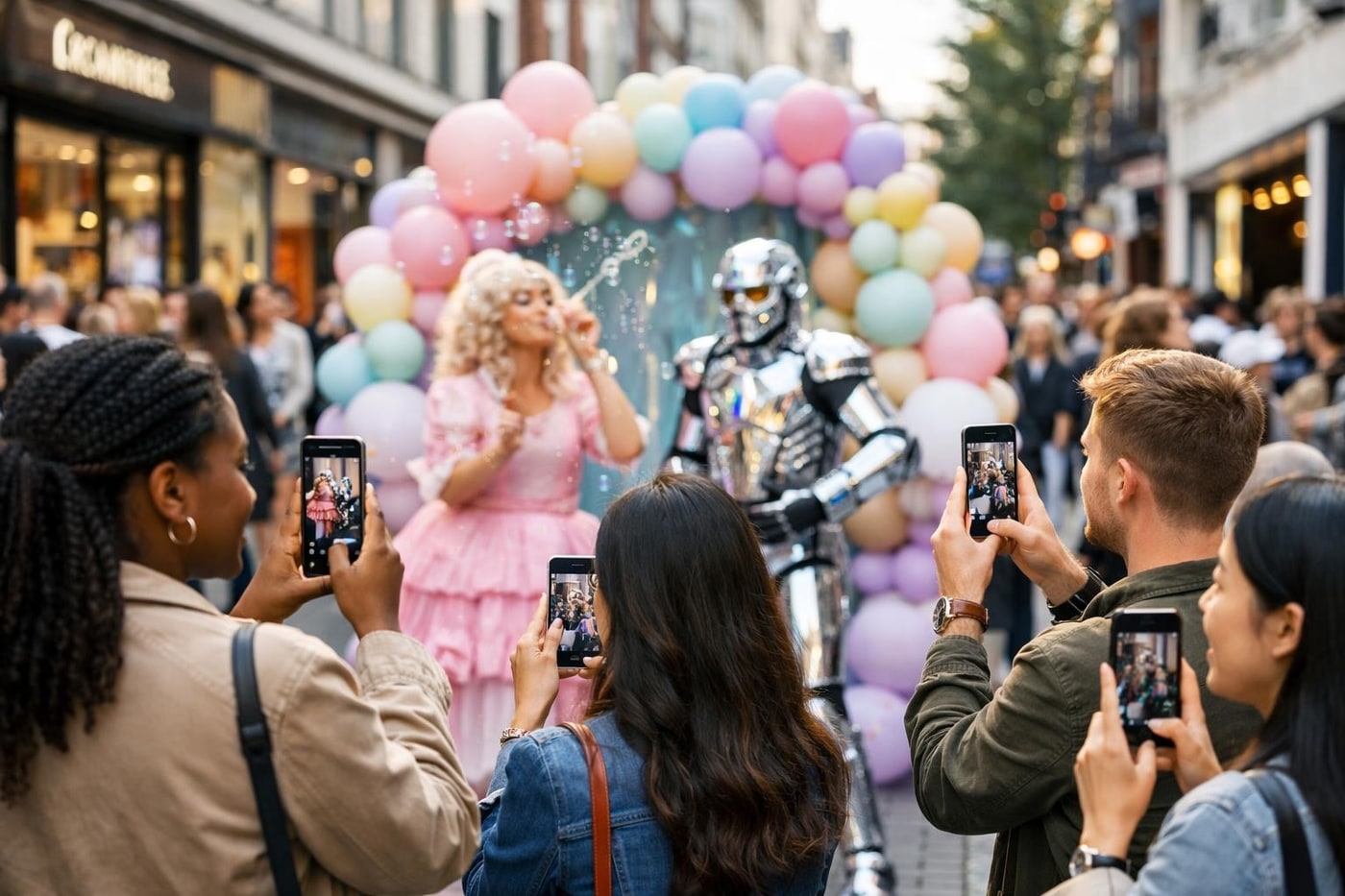
At the Swatch event, influencers and members of the public captured and shared content in real time. This extended the reach of the activation far beyond the location itself.
Designing for flow and accessibility
Retail environments require simplicity. People should not have to think about how to engage. The activation should guide them naturally.
This includes:
- Clear entry points
- Open layouts
- Visible areas of activity
If the experience feels confusing or difficult to access, people will not engage. Clarity increases participation.
Maintaining energy throughout the day
Retail activations often run for extended periods. Energy needs to be consistent.
This is achieved through:
- Scheduled performance moments
- Continuous music
- Active engagement from the team
Without this, the activation can feel flat during quieter periods. Consistency keeps the experience alive.
Integrating the team into the experience
The team delivering the activation plays a crucial role. They are not just operational. They are part of the experience.
They should:
- Engage naturally with guests
- Encourage participation
- Represent the brand
A strong team increases comfort and confidence for guests. This leads to higher engagement.
Avoiding common retail experiential mistakes
There are several pitfalls that can reduce effectiveness. Being too subtle is one. If the activation does not stand out, it will be ignored. Overcomplicating the experience is another. If people do not understand quickly, they disengage. A lack of energy can also reduce impact. Finally, disconnecting the experience from the brand weakens the overall message.
Each of these can be avoided with a clear and focused approach.
Measuring success in retail experiential marketing
Success should be measured through engagement, not just visibility. Key indicators include:
- Number of interactions
- Time spent at the activation
- Product engagement
- Social content created
These metrics provide a clearer picture of impact.
Why experiential marketing requires expertise
Retail experiential marketing is not simple. It requires understanding of human behaviour, creative thinking and operational delivery. It must work in real-world environments. This is what ensures the activation delivers results.
Final thought
Retail experiential marketing is about more than visibility. It is about creating a moment within a busy environment that people choose to be part of. When done properly, it transforms passing footfall into real engagement and lasting brand connection.
Planning a retail experiential campaign
Events by Knight specialises in designing and delivering experiential retail activations that capture attention and drive meaningful engagement in high-footfall environments. From concept through to execution, every detail is carefully considered to ensure your campaign performs in the real world.
If you are planning a retail activation or brand launch, speak to our team about bringing your vision to life.


